Paperboard Grades Explained: SBS vs CCNB vs Kraft vs Greyboard
Paperboard is the foundation of almost every custom box, yet the terminology is confusing: SBS, C1S, FBB, CCNB, kraft, greyboard, corrugated, gsm, points, caliper. Choosing the wrong board leads to dull colors, weak boxes or unnecessary cost. Choosing the right one makes your packaging look sharper, perform better and cost less.
This guide explains the main paperboard grades used in packaging, how board weight and thickness are measured, and how to choose the right material for folding cartons, rigid boxes and shipping boxes.
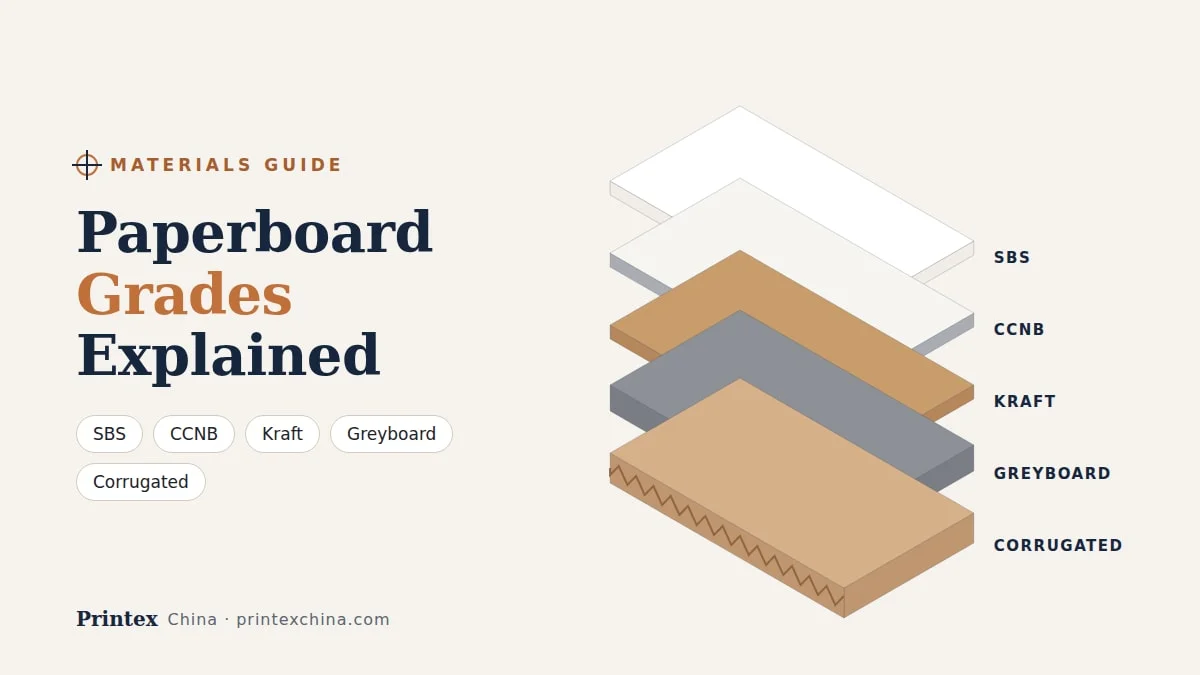
Quick answer: Use SBS / C1S white board for premium printed retail cartons, CCNB (grey-back) for cost-effective cartons, kraft board for a natural look, greyboard (chipboard) wrapped in paper for rigid boxes, and corrugated board for mailers and shipping boxes.
How Paperboard Is Measured
- Grammage (gsm or g/m²): weight per square metre. It is the most common specification in Asia and Europe. Folding carton board typically ranges from about 250 to 450 gsm.
- Caliper (thickness): measured in millimetres or in points (pt) in North America, where 1 pt = 0.001 inch (about 0.0254 mm). For example, 18 pt is roughly 0.46 mm.
- Stiffness: how rigid the board feels. Two boards with the same gsm can differ in stiffness depending on fibre and construction.
Because gsm and caliper don't convert exactly between grades, specify both, or ask your supplier to recommend a board by product weight and box size.
SBS / C1S (Solid Bleached Sulfate)
SBS is a premium board made from bleached virgin fibre, white through and through, with a coated print surface on one side (C1S) or both sides (C2S).
- Best for: cosmetics, fragrance, pharmaceuticals, premium food and electronics cartons.
- Pros: bright white surface, excellent color reproduction, clean white edges and food-contact suitable grades available.
- Cons: higher cost than recycled boards.
See our cosmetic packaging guide for how SBS is used in beauty.
FBB (Folding Box Board)
FBB has a multi-layer construction with mechanical pulp in the middle and bleached chemical pulp on the outside. It is lighter and stiffer for its weight than SBS.
- Best for: food, confectionery, health and personal care cartons.
- Pros: good stiffness-to-weight ratio, white print surface and often a cream-colored reverse side.
- Cons: the inside may be slightly off-white.
CCNB / Grey-Back Board (Recycled)
CCNB (Clay Coated News Back), often called grey-back or duplex board, is made from recycled fibre with a white clay-coated top and a grey back.
- Best for: household goods, toys, cereal and dry-food cartons, and cost-sensitive retail packaging.
- Pros: economical, recycled content and a decent white print surface.
- Cons: grey inside and edges, slightly less bright print, and usually not suitable for direct food contact without a barrier.
Kraft Board
Kraft board is unbleached, natural brown board with strong fibres. It is also available as white-top kraft (a white surface on a kraft base).
- Best for: eco-positioned brands, candles, food, apparel and artisan products.
- Pros: strong, natural look and pairs beautifully with debossing and one-color printing.
- Cons: colors print darker and less vibrant, and a white ink underlay is needed for bright colors.
See our sustainable packaging guide for more on eco-friendly materials.
Greyboard (Chipboard) for Rigid Boxes
Greyboard is a dense, thick board made from recycled fibre, typically 1–3 mm thick. It isn't printed directly. Instead, it is wrapped in printed art paper or specialty paper to create rigid boxes.
- Best for: rigid boxes, magnetic boxes, two-piece gift boxes and book-style packaging.
- Pros: very rigid, premium hand-feel and endless wrap paper options.
- Cons: heavier and higher cost, and set-up boxes don't ship flat unless collapsible.
Common thicknesses are around 1.5 mm for small items, 2 mm for most gift and cosmetics boxes, and 2.5 mm or more for heavy products.
Corrugated Board
Corrugated board has a fluted middle layer between two liners. It is the standard for shipping and e-commerce.
- E-flute (about 1.5 mm): the most common choice for printed mailer boxes.
- B-flute (about 3 mm): more cushioning for heavier items.
- F-flute (about 0.8 mm): thin with a premium print surface.
- Double-wall (such as EB or BC): for heavy or fragile shipments.
Liners can be kraft, white or laminated with printed paper (litho-lam). See our mailer box guide and corrugated mailers.
Specialty Papers and Boards
- Metallic and holographic boards: eye-catching for makeup, gifts and limited editions.
- Textured and embossed papers: linen, leather-grain and felt textures for rigid box wraps.
- Colored-through papers: color all the way through, so edges and folds stay clean.
- Cotton, bamboo or other alternative-fibre papers: niche options for sustainability stories.
How to Choose the Right Board
- Start with the structure: folding carton, rigid box or corrugated mailer. This narrows the options immediately. See our comparison of rigid boxes and folding cartons.
- Consider product weight: heavier products need thicker or stiffer board, or a structure like an auto-lock bottom.
- Match the print quality to the brand: SBS for vibrant, precise color; kraft for natural; CCNB for budget.
- Check food contact: use food-grade board or a barrier for direct contact. See our food packaging guide.
- Think about sustainability claims: FSC-certified or recycled board supports your claims.
- Balance cost: ask for quotes on two board options. A small change in board can make a meaningful difference at volume.
Quick Reference by Product
- Skincare carton: SBS around 300–350 gsm, with an auto-lock bottom for heavier glass.
- Supplement or household carton: CCNB or FBB, depending on budget and look.
- Candle box: kraft or SBS with an insert. See our candle box guide.
- Luxury gift box: 2 mm greyboard wrapped in specialty paper.
- E-commerce mailer: E-flute corrugated with kraft or white liner.
These are starting points. The right specification depends on your product, structure and distribution, so always confirm on a sample.
Paperboard and Sustainability
- FSC certification is available for most grades, including SBS, FBB, kraft and recycled boards, and supports responsible sourcing claims.
- Recycled content is highest in CCNB, greyboard and many corrugated grades.
- Mono-material design: boards are easiest to recycle when they aren't combined with plastic windows, foam inserts or heavy film lamination.
- Lightweighting: a stiffer board grade can sometimes deliver the same strength at a lower grammage, which saves material and freight.
Common Material Mistakes
- Specifying gsm only, without considering board type and stiffness.
- Using recycled grey-back board for direct food contact without a barrier.
- Expecting bright colors on kraft without a white underlay.
- Choosing board that is too light for heavy glass, which leads to bulging panels and failing tuck flaps.
- Not approving a physical sample, because board feel and color can only be judged in the hand.
Frequently Asked Questions
What does 350 gsm mean?
It means the board weighs 350 grams per square metre. Higher gsm generally means a thicker, stiffer board, but stiffness also depends on the board type.
Is SBS better than CCNB?
SBS offers brighter print and cleaner white edges and is preferred for premium and food-contact uses. CCNB is more economical and contains recycled fibre, which makes it a good choice for many retail products.
What thickness is a rigid box?
Rigid boxes typically use greyboard about 1.5–2.5 mm thick, wrapped in printed or specialty paper.
Can you send board samples?
Yes. We can send material swatches and white samples so you can compare board feel, stiffness and print surface before choosing.
Find the Right Material for Your Box
Tell us your product, structure and budget. Printex China will recommend two or three board options, send material samples and quote them side by side so you can choose with confidence. Browse our packaging styles to get started.