Packaging Quality Control: How IQC, IPQC, FQC and AQL Inspection Work
When packaging arrives with the wrong color, crushed corners or boxes that won't close, the damage goes beyond the reprint. It delays launches, holds up production lines and frustrates retail partners. The way to prevent it is a clear quality control (QC) process, agreed with your supplier before production starts.
This guide explains how packaging quality control works: the three inspection stages, what AQL sampling means, which defects matter most, how color is controlled and what you should agree on with your manufacturer before your order goes to press.
Quick answer: Good packaging QC has three stages: IQC (incoming materials), IPQC (in-process checks during printing, finishing and assembly) and FQC (final inspection). Final inspection uses AQL sampling, a statistical method that checks a defined number of boxes from each lot against agreed defect limits.
Why Packaging Quality Control Matters
- Brand consistency: color and print quality must match across products and reorders.
- Function: boxes must fold, close, hold the product and run on packing lines.
- Protection: weak board, poor gluing or loose inserts cause damaged products.
- Cost and time: defects found after delivery are far more expensive to fix than those caught at the factory.
The Three Stages of Packaging QC
1. IQC: Incoming Quality Control
Materials are checked when they arrive at the factory, before production:
- Paperboard grade, thickness (caliper) and grammage against the specification.
- Board moisture content and flatness, which affect printing and folding.
- Inks, foils, laminating films, glues and magnets checked against approved standards.
- Certificates for FSC or other material claims, where required.
2. IPQC: In-Process Quality Control
Checks are made at each production step:
- Printing: color measured against the approved sample, registration, ink density and visual defects such as spots or streaks.
- Lamination and coating: adhesion, bubbles, wrinkles and scratches.
- Finishing: foil sharpness and coverage, spot UV registration and emboss depth.
- Die-cutting and creasing: cut accuracy, clean edges and crease quality (no cracking).
- Gluing and assembly: glue strength, squareness, wrapping quality on rigid boxes and magnet placement.
3. FQC: Final Quality Control
Finished boxes are inspected before packing and shipping. They are checked for appearance, dimensions, structure, function and packing, using AQL sampling.
What Is AQL and How Does It Work?
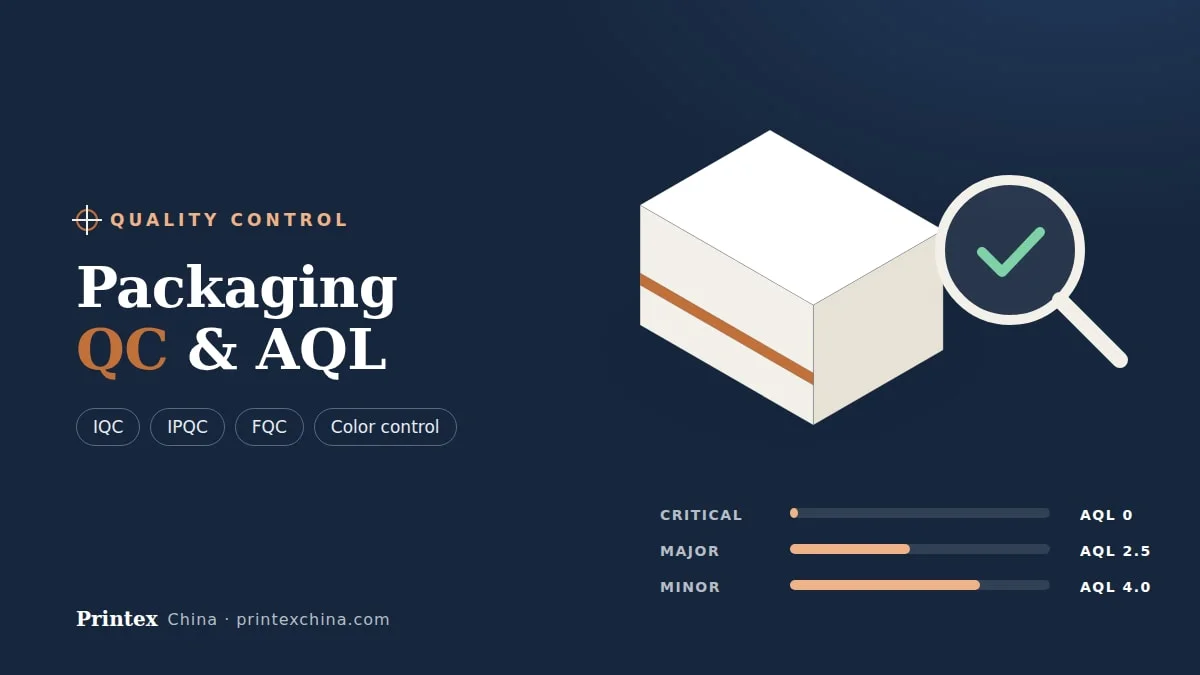
AQL (Acceptance Quality Limit) is a statistical sampling method, defined in standards such as ISO 2859-1, used to decide whether a production lot is acceptable without checking every single box.
- Lot size determines the sample size. For example, a lot of several thousand boxes might require a sample of a couple of hundred units at the standard general inspection level (Level II).
- Each defect found is classified as critical, major or minor.
- Each class has an AQL value that sets the maximum number of defects allowed in the sample. If defects exceed this number, the lot fails and is reworked or remade.
A common setting for consumer packaging is critical: 0, major: 2.5, minor: 4.0, but stricter limits can be agreed for premium or regulated products.
Defect Classification for Packaging
Critical defects
Critical defects can cause harm, legal problems or make the packaging unusable. Examples include wrong product information or barcodes, missing mandatory text, the wrong design in the wrong box, or contamination on food-contact packaging.
Major defects
Major defects affect function or clearly affect appearance. Examples include a visible color deviation from the standard, boxes that won't close or fold properly, glue failure, dimensions out of tolerance, large scratches or stains, and misregistered foil or spot UV.
Minor defects
Minor defects are small cosmetic issues unlikely to affect the customer's decision. Examples include tiny spots, slight scuffs on non-display panels and very small edge imperfections.
Agree on the classification with your supplier in writing. One brand's "minor" can be another brand's "major", especially for luxury packaging.
How Color Is Controlled
Color is the most common packaging dispute, so it needs a clear standard:
- Approved physical standard: the signed pre-production sample (PPS) or color proof becomes the reference.
- Pantone references for brand-critical colors.
- Spectrophotometer measurement: color is measured numerically and compared with the standard using a color difference value (Delta E), with an agreed tolerance.
- Standard lighting: visual checks in a light booth under standard illumination, so color is judged consistently.
At Printex China, color is checked against the approved sample with spectrophotometers during production.
Functional and Durability Testing
- Fit test: the real product placed in the box and insert.
- Closing and opening: tuck flaps, magnets and lids work smoothly.
- Drop test: packed boxes dropped on corners, edges and faces, especially for e-commerce. See our mailer box guide.
- Compression and stacking: for shipping cartons and heavy products.
- Rub and scuff resistance: for dark, soft-touch or foil-heavy designs.
- Climate conditions: humidity and temperature can affect board, glue and lamination, which matters for long sea freight and tropical destinations.
What to Agree With Your Supplier Before Production
- Specification sheet: structure, dimensions and tolerances, board, printing, finishing, inserts and packing method.
- Approved samples: white sample for structure and pre-production sample for color and finishing, signed by both sides.
- AQL levels and the defect classification list.
- Color tolerance and how it will be measured.
- Packing requirements: quantity per carton, interleaving sheets for delicate finishes, carton labels and pallet specifications.
- Inspection report: what the final QC report will include, such as photos, measurements and defect counts.
- Third-party inspection: if you plan to use an independent inspector, agree the timing in advance.
A Typical QC Timeline for an Order
- Before production: specification sheet, white sample and pre-production sample approved and signed; AQL levels and color tolerance agreed.
- Material arrival: IQC checks board, paper, inks and accessories against the specification.
- First-article check: the first sheets off the press and the first finished boxes are compared with the approved sample before the full run continues.
- During production: IPQC checks at regular intervals at printing, finishing, die-cutting and gluing.
- Before packing: FQC performs AQL sampling on finished goods and checks packing and labeling.
- Before shipping: the inspection report with photos and measurements is shared with you, and an optional third-party inspection can take place.
How to Read a QC Report
A useful final inspection report should tell you, at a glance, whether the lot passed and why. Look for:
- Lot size, sample size and the AQL levels used.
- The number of critical, major and minor defects found, against the allowed limits.
- Photos of the boxes, packing, carton labels and any defects.
- Measured dimensions and color readings compared with the standard.
- Functional test results, such as fit, closure and drop tests where applicable.
Common Causes of Packaging Defects
- Artwork problems such as missing bleed, RGB images or low-resolution files. See our dieline and artwork guide.
- Board that is too light for the product or structure.
- Humidity changes causing warping or glue issues.
- Skipping a pre-production sample to save time.
- Vague specifications, such as "good quality" with no defined standard.
How Printex China Controls Quality
Every order follows a three-stage QC process. IQC checks paper, board and inks on arrival. IPQC covers color matching against the approved sample, lamination adhesion and die-cut accuracy. FQC is the final inspection of structure, finish and overall appearance before packing. The process follows AQL standards, and our in-house testing lab includes drop testers, spectrophotometers, climate chambers and rub testers. We are ISO 9001 certified, FSC certified and audited for social compliance (Sedex/BSCI, SMETA), and we are Disney-audited.
Frequently Asked Questions
What AQL level should I use for packaging?
A common choice is general inspection level II with AQL 0 for critical, 2.5 for major and 4.0 for minor defects. Premium brands sometimes use stricter limits for major defects.
Can I use a third-party inspection company?
Yes. Many buyers book an independent pre-shipment inspection. Agree the AQL levels and defect list in advance so both sides inspect against the same standard.
How do you make sure reorders match the first order?
We keep the approved standard sample and color data on file, and measure each new run against them.
What happens if a lot fails inspection?
The lot is sorted, reworked or reproduced, depending on the defect, before shipping.
Quality You Can Measure
Tell us your quality requirements, or ask us to propose a QC plan for your packaging. Printex China will agree specifications, AQL levels and color tolerances with you before production, and share inspection reports before every shipment. Learn more about why brands choose Printex China.