Rigid Box vs Folding Carton: How to Choose the Right Packaging
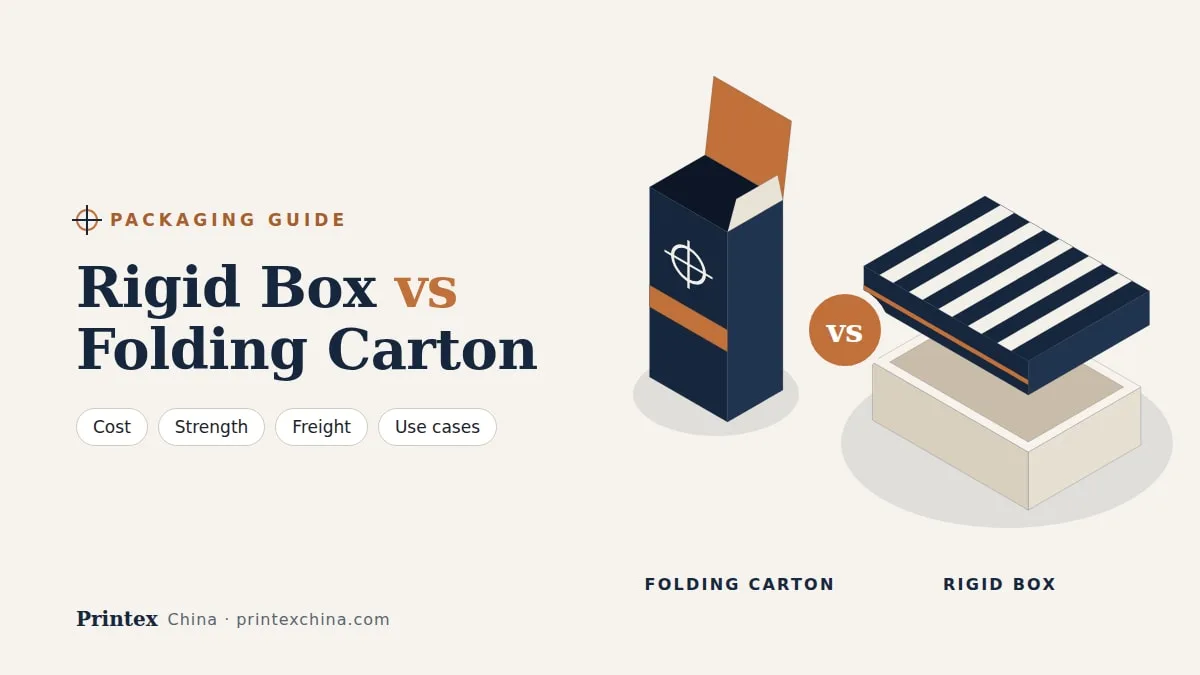
If you are developing packaging for a new product, one of the first decisions you will make is also one of the most expensive to get wrong: should it be a rigid box or a folding carton? The two look similar in a product photo, but they differ in cost, construction, freight, lead time and the message they send to your customer.
This guide breaks the choice down the way a packaging engineer would. It covers materials, structure, real cost drivers, logistics and the product categories where each one performs best, so you can brief your supplier with confidence.
Quick answer: Choose a folding carton when you need cost-efficient retail packaging at volume, flat shipping and fast replenishment. Choose a rigid box when unboxing and perceived value drive the sale, as with premium cosmetics, fragrance, jewelry, electronics and gift sets, and when a higher unit cost is justified by the price of the product inside.
What Is a Folding Carton?
A folding carton is a box made from a single sheet of paperboard that is printed, die-cut, creased and glued, then shipped flat to you. It is erected and filled on your packing line or by hand. Most retail shelves are dominated by folding cartons, from toothpaste and supplements to cosmetics and small electronics.
Typical materials
- SBS (solid bleached sulfate) / C1S white board: a bright white surface for premium print quality, common in cosmetics and pharma.
- CCNB / grey-back board: recycled board with a white coated top. It is more economical and widely used for food and household goods.
- Kraft board: a natural brown look that suits eco-positioned and artisan brands.
Board is usually specified by weight or thickness, commonly around 300–400 gsm (roughly 14–24 pt) depending on product weight and how stiff the panels need to feel.
Common folding carton styles
- Reverse tuck end and straight tuck end: the everyday retail carton for light products.
- Auto-lock (crash-lock) bottom: pops into shape instantly and carries heavier items such as bottles and jars.
- Sleeves, window cartons, gable boxes and display trays: for visibility, portability or shelf-ready merchandising.
See examples on our folding cartons page.
What Is a Rigid Box?
A rigid box, also called a set-up box, is built from thick greyboard (chipboard), usually 1.2–3 mm. The board is cut to shape and then wrapped in a printed or specialty paper. Unlike a folding carton, it does not fold flat. It arrives fully constructed, which is exactly why it feels so solid in the hand.
Common rigid box styles
- Lid and base (telescope): a classic two-piece gift box. See our two-piece boxes.
- Magnetic closure / book style: a hinged lid with hidden magnets, widely used for cosmetics sets, tech accessories and premium gifts.
- Drawer (sliding) box: a tray slides out of a sleeve. It is popular for jewelry, chocolates and PR kits.
- Shoulder-neck box: a three-piece structure with a visible collar. It is often used for fragrance and luxury candles.
- Collapsible (foldable) rigid box: a rigid look that folds flat for shipping. It is covered in detail below.
Explore structures on our rigid boxes page.
Rigid Box vs Folding Carton: Side-by-Side
1. Unit cost
This is the biggest difference. A rigid box involves more material, several manual or semi-automatic steps (cutting board, wrapping, pressing, attaching magnets or ribbons) and more quality checks. As a rule of thumb, a rigid box costs several times more per unit than a folding carton of similar size, often 3 to 10 times more depending on structure and finishing.
Indicative ranges only (they vary widely with size, quantity and finish):
- Folding cartons at a few thousand units: often a few cents to under one US dollar per unit.
- Rigid boxes at the same quantity: commonly one to several US dollars per unit, and more with inserts, magnets or special papers.
The right question is not "which is cheaper" but "what percentage of my retail price can packaging take?" For a USD 120 serum set, a USD 3 rigid box can be a strong investment. For a USD 9 lip balm, it usually is not.
2. Protection and structural strength
Rigid boxes resist crushing far better and keep their shape through repeated opening, which is important for keepsake and reusable packaging. Folding cartons protect against scuffs and dust but depend on the product, inserts and shipper for compression strength. For e-commerce, both are usually placed inside a corrugated outer. See our corrugated mailers.
3. Perceived value and unboxing
The weight, slow lid lift and crisp wrapped edges of a rigid box communicate "premium" before the product is even seen. That matters in categories where the box becomes part of the gift, gets photographed for social media or is kept afterward. A well-printed folding carton can also look high-end, especially with foil or embossing, but it rarely matches the tactile impression of a rigid box.
4. Shipping, storage and freight
This is the hidden cost many brands underestimate. Folding cartons ship and store flat, so thousands fit on a single pallet. Standard rigid boxes ship fully assembled, so you are paying to move and store air. For ocean or air freight from China, the volumetric difference can be dramatic and can erase some of the unit-price savings you negotiated.
Collapsible rigid boxes are the middle ground. They keep a rigid look and feel, fold flat for transport and are erected at your warehouse in seconds. For direct-to-consumer brands paying for 3PL storage, this is often the smartest option.
5. MOQ and lead time
- Folding cartons run on highly automated lines. Offset printing becomes economical from around 500 units. For market tests, digital printing can go lower, which suits frequent SKU changes and seasonal designs.
- Rigid boxes need more hands-on assembly, so sample and production lead times are usually longer, especially with magnets, ribbons or custom inserts.
At Printex China, samples can be ready in as little as 7 days after artwork approval, and mass production typically takes 15–30 days depending on quantity and complexity.
6. Sustainability
Both can be made from FSC-certified, recyclable paper. Folding cartons use less material per unit and have a smaller freight footprint. Rigid boxes use more board, but consumers tend to keep and reuse them, which extends their useful life. Avoid mixed materials such as plastic windows or PVC inserts if recyclability is a key message. Paper-based inserts are available for both formats.
7. Customization and finishing
Both formats accept CMYK and Pantone printing, foil stamping, spot UV, embossing and soft-touch lamination. Rigid boxes additionally allow specialty wrap papers, such as textured, linen-feel, metallic or colored-through stocks, which give a luxurious look even with minimal printing. Read our guide to packaging finishes for details.
Which One Should You Choose? By Industry
- Skincare and cosmetics: folding cartons for single SKUs on shelf. Rigid or magnetic boxes for gift sets, PR kits and launches. See cosmetic boxes.
- Fragrance: rigid boxes (shoulder-neck, lid and base) with a fitted insert are the category standard for premium lines. See perfume boxes.
- Candles: folding cartons for everyday lines and rigid two-piece boxes for luxury or holiday editions. See candle boxes.
- Jewelry and watches: rigid drawer or lid-and-base boxes with foam or paper inserts.
- Consumer electronics: rigid lid-and-base boxes with molded pulp or paperboard inserts for flagship products, and folding cartons for accessories.
- Supplements, food and beverage: mostly folding cartons, with rigid boxes for limited editions and corporate gifting.
- Apparel and accessories: collapsible rigid or corrugated mailer boxes for DTC, and folding cartons for small accessories.
Hybrid Solutions Worth Considering
- Folding carton + premium finishing: foil, embossing and soft-touch can move a carton much closer to a luxury feel at a fraction of rigid-box cost.
- Rigid box + printed paper sleeve: a plain stock rigid box carries a SKU-specific sleeve, which lets one box serve many products and reduces inventory.
- Collapsible rigid box: rigid presentation with flat-pack logistics.
- Folding carton with a paperboard insert: holds bottles or multiple items securely without moving to a rigid structure.
A 6-Question Decision Checklist
- What is the retail price, and what packaging budget per unit does that allow?
- Will the box sit on a retail shelf, ship direct to consumers, or both?
- Is unboxing, gifting or social sharing a meaningful part of the purchase?
- How much warehouse space and freight budget do you have?
- How many SKUs, and how often will artwork change?
- Do you need the box to be reusable or kept by the customer?
If most of your answers point to volume, shelf and replenishment, start with a folding carton. If they point to gifting, presentation and a high retail price, a rigid box (or a collapsible rigid box) will likely pay for itself.
Common Mistakes to Avoid
- Choosing on unit price alone and ignoring freight and storage for set-up rigid boxes.
- Specifying board that is too light for heavy products, which leads to bulging panels and failed tuck flaps.
- Skipping a physical sample. Always approve a pre-production sample so you can check fit, color and closing force before mass production.
- Forgetting the insert. A great box with a loose product feels cheap. Plan the insert together with the structure.
Frequently Asked Questions
Is a rigid box always more expensive than a folding carton?
For comparable sizes and quantities, yes. Rigid boxes use more material and labor. The gap narrows when a folding carton needs heavy finishing and inserts, or when freight for set-up rigid boxes is handled with collapsible structures.
Can a folding carton look premium?
Absolutely. Good board selection, precise color, foil stamping, embossing and soft-touch lamination can make a folding carton look luxurious. The difference is mainly in weight and tactile feel.
What is the minimum order quantity for custom boxes?
Our standard MOQ is 500 units for offset printing. Digital printing supports smaller runs from around 250 units, which is ideal for testing a design before scaling.
How do I choose the right size?
Measure the product's inner dimensions (length × width × height) and allow for any insert. Our engineering team can create a dieline for you and send a white sample to confirm the fit before printing.
Get Expert Advice on Your Box
Still undecided? Send us your product dimensions, target quantity and retail price range. Printex China's packaging engineers will recommend the most cost-effective structure, whether that is a folding carton, rigid box or a hybrid, and quote both options side by side so you can compare.