Magnetic Closure Boxes: The Complete Guide to Structures, Materials & Cost
Few packaging formats say "premium" as clearly as a magnetic closure box. The soft snap of the lid, the weight of the rigid board and the clean, uninterrupted lines make it the go-to choice for beauty sets, fragrance, jewelry, tech accessories, corporate gifts and influencer PR kits.
A magnetic box also has more variables than most brands expect: board thickness, magnet strength, wrap paper, insert design and whether the box can ship flat. This guide covers each of them, so you can specify a magnetic gift box that looks right, closes right and arrives in perfect condition.
In short: a magnetic closure box is a rigid box made from thick greyboard wrapped in printed or specialty paper, with thin magnets hidden under the wrap to hold the lid closed. Choose a fixed (set-up) version for maximum rigidity, or a collapsible version to cut freight and storage costs significantly.
What Is a Magnetic Closure Box?
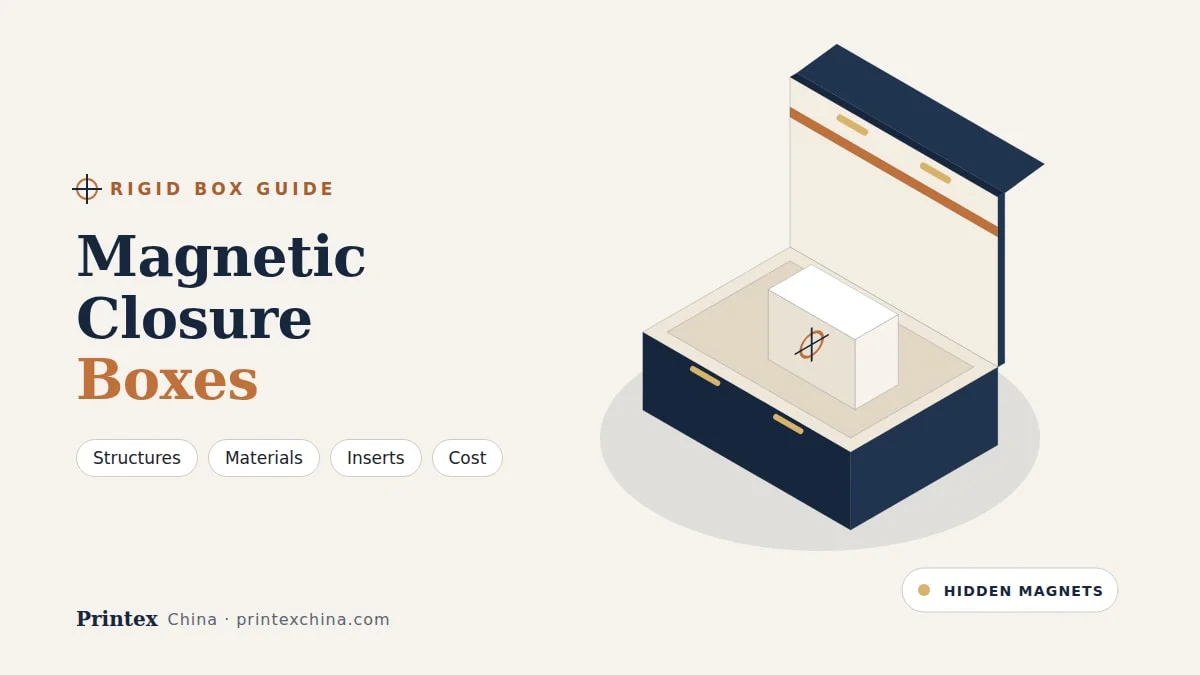
A magnetic closure box, often called a book-style box or flip-top box, is a type of rigid box. The base tray and a hinged cover are made from greyboard (chipboard), typically 1.5–2.5 mm thick, and wrapped in paper. Small, flat magnets are embedded under the wrap in the front flap of the lid and in the matching position on the base. When the lid closes, they pull together for a secure, satisfying snap without any visible fastener.
Because nothing is visible from the outside, the box keeps a clean silhouette that works well with minimalist branding, foil logos and textured papers.
The Main Magnetic Box Structures
1. Book-style (flip-top) magnetic box
This is the classic structure. The lid is hinged along the back and folds over the top with a front flap that drops down over the base. It suits cosmetics sets, skincare kits, tech accessories and premium stationery.
2. Collapsible (foldable) magnetic box
The walls fold down flat and the box ships as a flat panel. On arrival, the customer or your packing team folds the sides up, and the walls are held in place by pre-applied adhesive tabs or the magnetic lid itself. It keeps most of the premium feel at a fraction of the shipping volume. For direct-to-consumer brands paying 3PL storage fees, this is often the most economical premium option.
3. Magnetic box with a drawer or double doors
Variations include double-door "cabinet" openings with magnets on both front flaps, and sleeves with a magnetic tab. These add drama to high-end launches and PR boxes.
4. Two-piece box with magnetic details
Some two-piece (lid and base) boxes use magnets in a side flap or a hinged inner lid for an extra layer of reveal.
Materials: What Makes a Magnetic Box Feel Premium
Greyboard thickness
- Around 1.5 mm: lighter boxes for small items such as jewelry, cards and accessories.
- Around 2 mm: the most common choice for cosmetics, gift sets and apparel accessories.
- 2.5 mm and above: heavy products such as glass bottles, electronics or large gift sets, or when you want a very solid hand-feel.
Wrap paper
- Printed art paper (typically 128–157 gsm): full-color CMYK or Pantone printing, usually laminated.
- Specialty papers: textured, linen-embossed, pearlescent, metallic or colored-through papers. They create a luxury look even without printing and hide minor handling marks.
- Kraft paper: natural and eco-positioned, and pairs beautifully with blind debossing.
Magnets
Packaging magnets are small, thin neodymium or ferrite discs or strips. The number, size and position of magnets determine how firmly the lid closes. Too weak and the lid pops open in transit. Too strong and the box is hard to open and may wear the wrap paper. Always test closing force on the white sample with the actual product inside, because the product's weight changes how the lid behaves.
Shipping note: the small magnets used in packaging are normally not a problem for sea or road freight. For air freight, mention the magnets to your forwarder so they can confirm there are no special requirements for your shipment.
Inserts: Holding the Product in Place
A magnetic box is only as good as its insert. A loose product rattling inside a premium box undermines the whole experience.
- Paperboard or greyboard inserts: recyclable, cost-effective and can be wrapped in the same paper as the box for a seamless look.
- EVA foam inserts: precise cavities and excellent protection for glass and electronics, often flocked or covered in fabric for a softer look.
- Molded pulp inserts: a plastic-free, protective option that suits eco-focused brands and tech products.
- Satin or velvet-lined inserts: the classic luxury look for jewelry, watches and fragrance.
- Ribbon pull tabs: a small detail that makes the product easy to lift out and adds to the unboxing moment.
Finishing Options
Magnetic boxes are the ideal canvas for premium finishes: soft-touch lamination with gold foil, blind embossing, spot UV on matte black, or a textured specialty paper with a single foil logo. Printing the inside of the lid, for example with a thank-you message or brand pattern, is an inexpensive way to make the reveal memorable. See our guide to packaging finishes for how each option works.
Design Tips for Magnetic Boxes
- Mind the wrap turn-ins. Wrap paper folds around the board edges and into the inside of the box, so keep critical artwork away from edges and ask for the wrap dieline, not just the box size.
- Let the lid tell the story. The lid top is the hero surface. A centered foil or embossed logo on a solid color is a classic for good reason.
- Consider the front flap. The drop-down flap is the first thing the customer's fingers touch, and it is a good place for a small debossed mark or a ribbon pull.
- Match inside and outside. A contrasting interior color or printed inner lid makes the opening moment feel intentional.
Cost: What Drives the Price of a Magnetic Box
Magnetic boxes are more labor-intensive than folding cartons because the board is cut, wrapped and pressed, and the magnets are placed by hand or on semi-automatic lines. The main cost drivers are:
- Size and board thickness: more board and more wrap paper.
- Fixed vs collapsible: collapsible boxes involve a slightly more complex construction, but the freight and storage savings usually outweigh this.
- Wrap paper: specialty papers cost more than printed art paper but can reduce printing costs.
- Finishing: each foil, emboss or UV effect adds a process step and sometimes tooling.
- Insert type: EVA and custom-cut foam cost more than a simple paperboard insert.
- Quantity: setup costs are spread across the run, so unit price drops significantly as volume grows.
As a guide, a magnetic box usually costs several times more per unit than a folding carton of similar size. That is why it is best suited to products where the packaging is part of the value. If you are still deciding between formats, read our comparison of rigid boxes and folding cartons.
Fixed vs Collapsible: Which Should You Choose?
- Choose fixed (set-up) when maximum rigidity matters, when the box is packed at your own facility close to the factory, or for very heavy or fragile products.
- Choose collapsible when you ship overseas, store inventory in a 3PL or run multiple SKUs. A shipment that fills a whole container as set-up boxes can take up a fraction of the space as flat-packed collapsible boxes.
Best Uses by Industry
- Cosmetics and skincare: gift sets, launch kits and PR boxes. See cosmetic boxes.
- Fragrance: book-style boxes with fitted inserts for bottles. See perfume boxes.
- Jewelry and watches: compact magnetic boxes with velvet or foam inserts.
- Electronics and accessories: magnetic boxes with EVA or pulp inserts for earbuds, smart devices and chargers.
- Apparel and accessories: collapsible magnetic boxes for scarves, ties and premium basics. See apparel boxes.
- Corporate gifting and events: branded welcome kits and seasonal gift sets. See gift boxes.
How to Order Magnetic Boxes: Step by Step
- Share your product: dimensions, weight and how many items go in each box.
- Choose the structure: fixed or collapsible, and the insert type.
- Select materials and finishes: board thickness, wrap paper and printing or foil.
- Approve a white sample: check fit, insert and magnet closing force.
- Approve a pre-production sample: confirm color and finishing.
- Mass production and shipping: typically 15–30 days of production, followed by sea or air freight.
Common Mistakes to Avoid
- Magnets that are too weak for a heavy product, so the lid opens in transit.
- Forgetting the insert, or designing it after the box. Plan them together.
- Dark soft-touch without protection: ship in polybags or with interleaving sheets to avoid scuffs.
- Ignoring freight: set-up boxes shipped overseas can cost more in freight than the boxes themselves.
Frequently Asked Questions
What is the MOQ for custom magnetic boxes?
Our standard MOQ for custom printed boxes is 500 units. For smaller test runs, ask about digital printing options.
Can magnetic boxes be recycled?
The box itself is paper-based. Magnets can be removed before recycling, and choosing paperboard or molded pulp inserts instead of foam makes the whole package easier to recycle.
How long does it take to make magnetic boxes?
Samples are typically ready in 2–7 days after artwork approval, and mass production usually takes 15–30 days depending on quantity and finishing.
Can the box be reused by customers?
Yes. Durability and reusability are among the biggest advantages of magnetic boxes. Customers often keep them for storage, which extends your brand's visibility well beyond the unboxing.
Design Your Magnetic Box With Us
Send us your product size, target quantity and reference images. Printex China will recommend the right structure, board and insert, make a white sample to test fit and closing force, and quote fixed and collapsible options side by side.