Child-Resistant Packaging Boxes: Standards, Testing & Paperboard Designs
Some products must be kept out of children's hands: medicines, supplements with iron, certain household chemicals, nicotine products and, in many markets, cannabis products. For these categories, child-resistant (CR) packaging is often a legal requirement. It must also remain usable for adults, including seniors.
This guide explains what child-resistant packaging is, how it is tested and certified, which paperboard structures are available, and what brands should plan for when developing CR boxes.
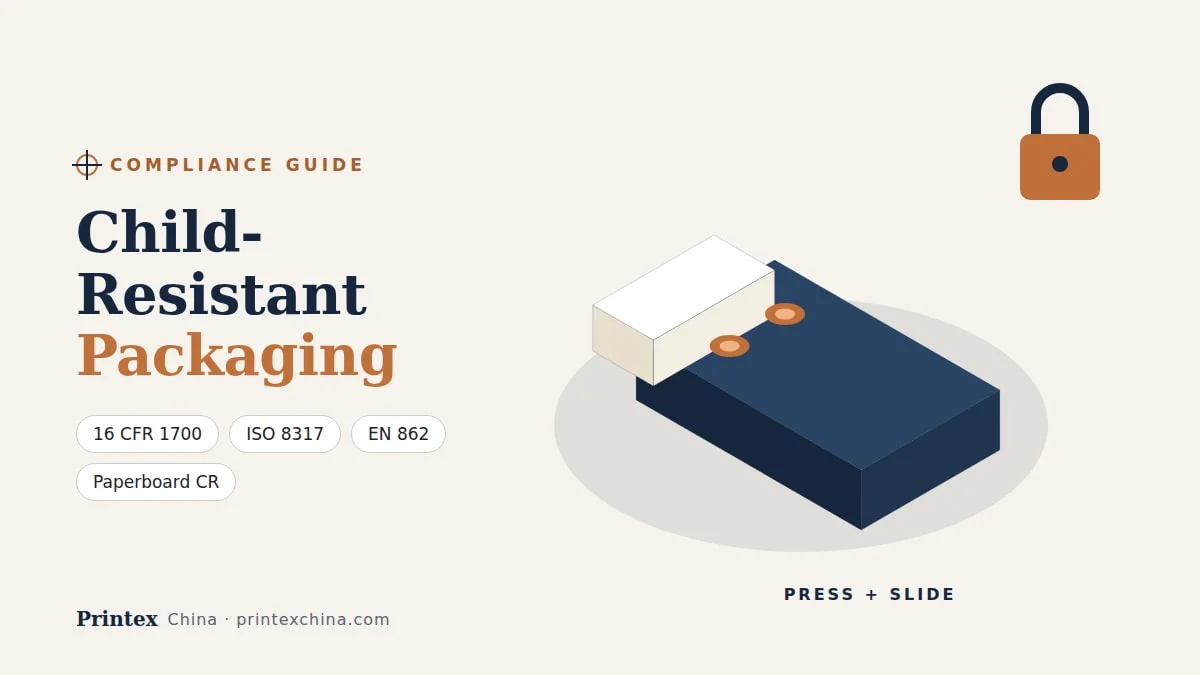
Quick answer: Child-resistant packaging is designed to be difficult for young children to open but not difficult for adults. In the US it is tested under 16 CFR 1700.20 with panels of children and senior adults, and in Europe under standards such as ISO 8317 (reclosable) and EN 862 (non-reclosable). Paperboard CR boxes use locking mechanisms, such as push-and-slide or press-and-pull, that require two coordinated actions to open.
What Makes Packaging "Child-Resistant"?
CR packaging is not "child-proof". It is designed so that most young children cannot open it within a set time, while most adults can open and properly close it. This is usually achieved by requiring a combination of actions that young children struggle to coordinate, such as pressing two points while sliding a drawer, or pushing a tab while pulling a tray.
Who Needs Child-Resistant Packaging?
- Pharmaceuticals, including many prescription and some over-the-counter medicines.
- Dietary supplements containing iron above certain levels, in some markets.
- Household chemicals, such as certain cleaning products and detergents.
- Nicotine products, including e-liquids in many markets.
- Cannabis and CBD products, where required by state or national regulations.
Requirements depend on the product, its ingredients and the market. Always confirm with your regulatory advisor which products need CR packaging and which standard applies.
How CR Packaging Is Tested
United States: 16 CFR 1700.20
Under the Poison Prevention Packaging Act, the US Consumer Product Safety Commission sets the test protocol in 16 CFR 1700.20:
- Child panel: groups of children aged 42 to 51 months try to open the package, first without and then after a demonstration. The packaging must achieve a child-resistant effectiveness of at least 85% without a demonstration and 80% after a demonstration (unit packaging has its own threshold).
- Senior adult panel: adults aged 50 to 70 must be able to open and, where applicable, properly re-close the package. The required senior adult use effectiveness is at least 90%.
Europe and international
- ISO 8317: for reclosable packaging.
- EN 862: for non-reclosable packaging of non-pharmaceutical products.
- EN 14375: for non-reclosable pharmaceutical packaging.
Testing is carried out by specialized accredited laboratories using real panels, and certification applies to the specific package design, so changes to structure, material or dimensions can require retesting.
Paperboard CR Packaging Structures
Push-and-slide (press-and-pull) drawer boxes
The most common paperboard CR format. A tray slides out of a sleeve only when locking points are pressed at the same time. It is used for blister packs, pouches, vape products and cannabis edibles.
Locking tuck boxes
Folding cartons with internal locks that release only when specific points are squeezed while the lid is lifted.
Rigid CR boxes
Premium rigid boxes with concealed locking mechanisms, for high-end products that need CR compliance with a luxury feel. See our rigid boxes.
Wallet-style blister packs
Paperboard wallets that hold blister cards, combining child resistance with patient-friendly dosing information.
Designing CR Packaging: Key Considerations
- Start from a certified mechanism: building on a proven, tested structure is faster and less risky than inventing a new lock.
- Board strength: CR locks rely on board stiffness. Lighter board may let children force the box open.
- Clear opening instructions: icons and short text showing how to open help adults and seniors.
- Product fit: the product must not shift in a way that makes the lock easier to bypass.
- Regulatory text: leave enough space for warnings, ingredient lists and dosing information.
- Brand presentation: CR packaging can still look premium with good printing, foil and soft-touch finishes. See our finishes guide.
The CR Development Process
- Confirm requirements: which product, market and standard apply.
- Select a structure: drawer, locking tuck or rigid, based on product and usage.
- Engineer and sample: dielines, white samples and fit tests with the actual product.
- Pre-test internally for obvious weaknesses before formal testing.
- Formal testing at an accredited laboratory, which can take several weeks.
- Lock the specification: board, dimensions and structure must stay the same in production to remain compliant.
- Production with QC: verify that locks function on every lot. See our QC and AQL guide.
Artwork and Labeling for CR Packaging
- Opening instructions: simple pictograms (for example, "press here" and "slide") placed directly on the locking points help adults open the box first time.
- Warnings: many regulated products require specific warning statements or symbols. Reserve space for them early.
- Avoid child-appealing designs where regulations or retailers restrict them, for example cartoon characters on cannabis or nicotine products in some markets.
- Tamper evidence: some products also need a tamper-evident seal or tear strip in addition to CR features.
- Accessibility: high-contrast text and clear instructions help senior adults use the package correctly.
Timeline and Budget Planning
CR packaging takes longer than standard packaging because of testing. Allow time for structure development and sampling, formal laboratory testing (often several weeks, depending on lab availability) and any redesign if the first test fails. Testing fees are separate from packaging costs and are charged by the laboratory. Building on a mechanism that has already passed testing reduces both risk and time.
Common Mistakes
- Changing the board or dimensions after certification without checking the impact.
- Designing the artwork before the mechanism is finalized.
- Locks that are too stiff for senior adults, which fail the senior panel.
- Forgetting the outer shipper. CR boxes protect children, not products in transit.
- Assuming one certification covers every market. Requirements and accepted standards differ.
Sustainability and CR Packaging
Paperboard CR boxes are a recyclable alternative to many plastic CR containers. FSC-certified board, water-based coatings and plastic-free inserts help reduce environmental impact while maintaining compliance. See our sustainable packaging guide.
Frequently Asked Questions
Is child-resistant the same as child-proof?
No. CR packaging is designed to be significantly difficult for young children to open within a set time, not impossible. Supervision and safe storage are still important.
Can paperboard boxes be child-resistant?
Yes. Push-and-slide drawer boxes and locking cartons made from strong paperboard are widely used and can be certified to recognized standards.
Who certifies child-resistant packaging?
Specialized, accredited testing laboratories perform the child and senior panel tests according to the relevant standard and issue test reports.
Do you make child-resistant boxes?
Yes. We produce paperboard and rigid CR structures. Tell us your product, market and required standard, and we will recommend a suitable mechanism and coordinate samples for testing.
Develop Your Child-Resistant Packaging
Send us your product details, target markets and the standard you need to meet. Printex China will recommend proven CR structures, engineer samples around your product and support you through testing and compliant production. See our child-resistant boxes and specialty structures.