Custom Packaging from China: MOQ, Cost & Lead Time Guide for Buyers
Sourcing custom boxes from China can cut your packaging costs significantly and give you access to finishing capabilities that are hard to find locally. It can also go wrong: unclear quotes, colors that do not match, delays at customs and inventory arriving weeks after launch. The difference almost always comes down to how well the project is briefed and managed.
This guide explains what first-time and experienced buyers need to know about minimum order quantities, what drives price, realistic lead times, artwork requirements and shipping terms, based on how a packaging factory actually quotes and produces your order.
Step 1: Understand MOQ (Minimum Order Quantity)
MOQ is not an arbitrary number. It reflects the fixed setup costs of a print run: printing plates, cutting dies, machine make-ready and color matching. Those costs are the same whether you print 500 boxes or 50,000, so they are spread across fewer units in a small order.
- Offset printing: the standard for consistent, high-quality color. At Printex China, the offset MOQ is 500 units, which is the point where plate and die costs become economical.
- Digital printing: needs no plates, so it supports runs from around 250 units. Per-unit cost is higher, but total investment is much lower, which makes it ideal for startups, market tests, limited editions and multiple SKUs.
Tip: Many brands launch on digital print and move to offset once a design is proven. Ask your supplier to quote both so you can see where the cost curves cross.
Step 2: Know What Drives the Price
Two quotes for "a custom box" can differ many times over because the specification is different. These are the main cost drivers, roughly in order of impact:
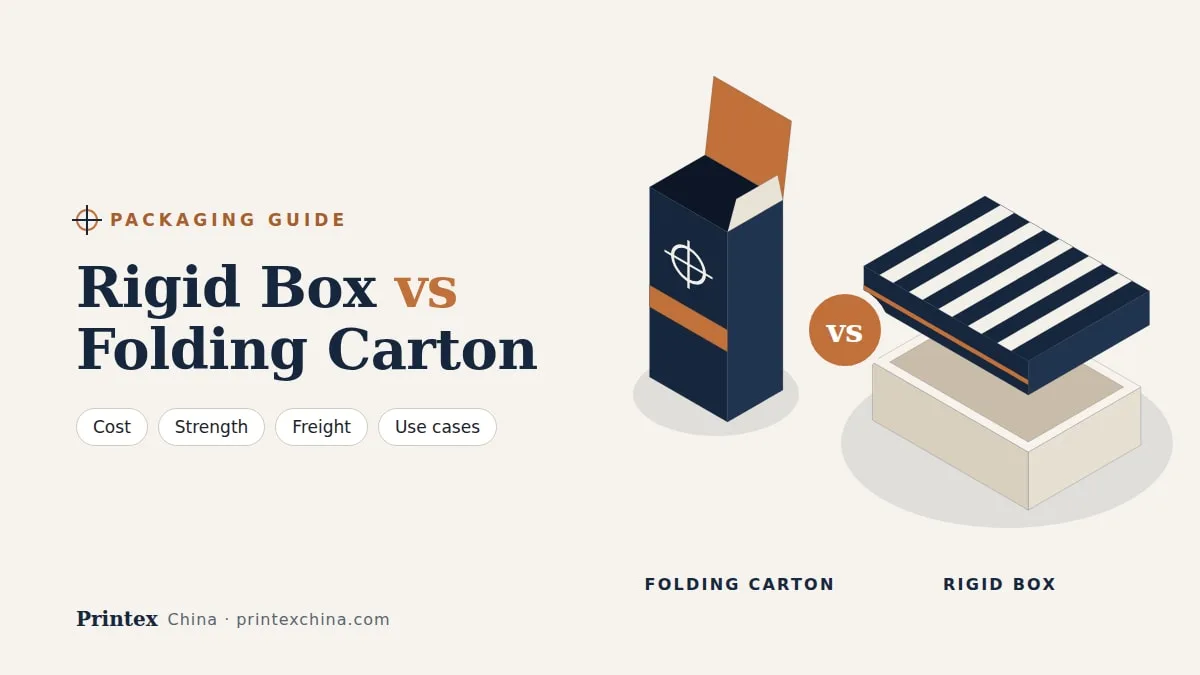
- Box structure: a folding carton, corrugated mailer and rigid box sit in very different price bands. See our comparison of rigid boxes vs folding cartons.
- Quantity: setup costs are spread over the run, so unit price falls steeply from 500 to 1,000 to 5,000 units.
- Size and material: board grade, thickness and sheet utilization, meaning how many boxes fit on one press sheet.
- Printing: number of colors, Pantone spot colors, printing inside and outside, and full-bleed coverage.
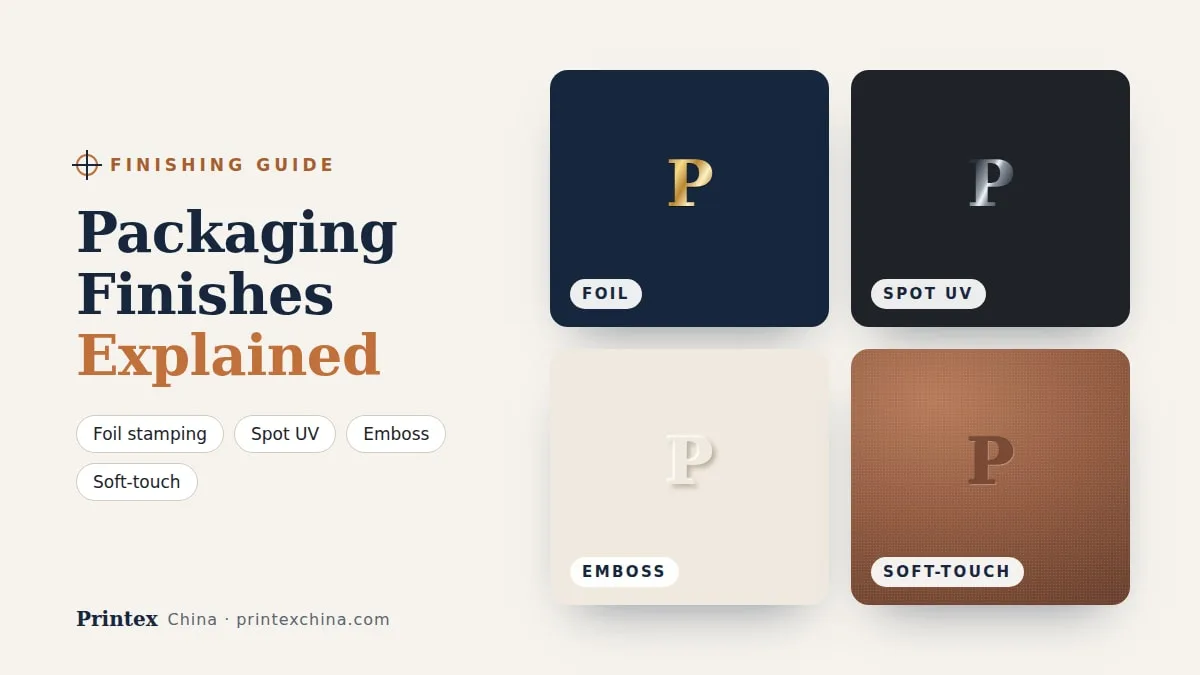
- Finishing: lamination, foil stamping, spot UV, embossing and debossing. Each adds a process step and sometimes a tooling cost (for example, foil and emboss blocks).
- Inserts and accessories: paperboard, EVA foam or molded pulp inserts, magnets, ribbons and windows.
- Assembly and packing: hand assembly, individual polybags and custom carton counts.
How to get an accurate quote: send internal dimensions (L × W × H), quantity per design, number of designs, preferred material, printing (CMYK, Pantone or both, inside or outside), finishing, insert requirements and your destination address. If you are unsure about any of these, say so. A good manufacturer will recommend options rather than guess.
What a good quote should include
A professional packaging quote is itemized, so you can see exactly what you are paying for and compare suppliers fairly. Look for:
- The full specification (structure, dimensions, board grade, printing, finishing and insert) written out, not just "custom box".
- Unit prices at several quantity breaks, for example 500, 1,000, 3,000 and 5,000 units.
- One-time costs listed separately: plates, cutting dies, foil and emboss blocks, and samples.
- Packing details: units per shipping carton, carton dimensions and gross weight, which you need to estimate freight.
- Lead times for samples and mass production, and the Incoterm the price is based on.
7 practical ways to lower your packaging cost
- Standardize sizes. One box size with a different insert or sleeve can serve several SKUs and consolidate volume into a single, cheaper run.
- Optimize dimensions for the press sheet. Small size changes can fit more boxes per sheet and noticeably cut material cost. Ask your engineer to check.
- Gang-run multiple designs. Printing several designs of the same size and material together shares setup costs.
- Be selective with finishing. One hero effect, such as a foil logo, often delivers most of the premium feel at a fraction of the cost of stacking several finishes.
- Choose flat-shipping structures. Folding cartons, corrugated mailers and collapsible rigid boxes dramatically reduce freight and storage volume.
- Order at a sensible quantity break. The jump from 1,000 to 3,000 units often lowers unit price enough to justify holding a little more stock.
- Plan ahead to avoid air freight. Sea freight is a fraction of the cost of air for bulky packaging. Late planning is the most expensive mistake.
Step 3: Plan a Realistic Timeline
Most delays happen before production even starts, usually waiting for artwork or sample approval. Here is a typical timeline for a custom packaging order from China:
- Technical confirmation (about 1 day): we review the style, board type and thickness, and check the dieline for production feasibility.
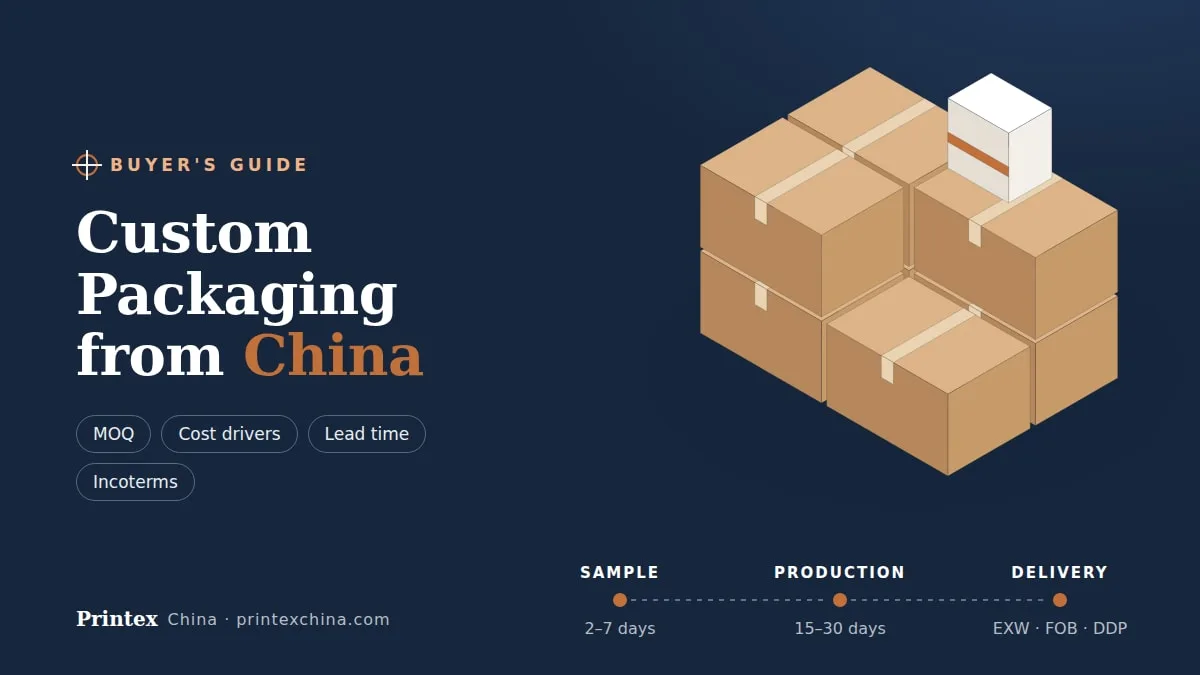
- Sample making (2–7 days): a white dummy (unprinted) to confirm structure and fit, then a color sample, then a complete pre-production sample (PPS) with a QC report.
- Sample delivery and approval (3–4 days transit + 1–2 days review): samples ship by DHL, FedEx or UPS. Once approved, the dieline and color standard are locked.
- Mass production (15–30 days): depends on quantity, structure and finishing, with inspections at each stage.
- Shipping: express air takes days, standard air roughly a week, and sea freight several weeks door to door depending on the destination and customs.
Rule of thumb: for a first order shipped by sea, allow around two to three months from brief to delivery. Repeat orders with locked artwork are much faster. Seasonal peaks such as Q4 and the period before Chinese New Year fill factory capacity early, so book production well ahead.
Step 4: Get Your Artwork Production-Ready
Artwork problems are the most common cause of reprints and delays. Follow these rules:
- Design directly on the manufacturer's dieline, the flat template showing cut and fold lines.
- Supply Adobe Illustrator (.ai) or high-resolution vector PDF files.
- Use CMYK color mode and specify Pantone (PMS) codes for brand-critical colors.
- Convert all text to outlines and embed or package all linked images at 300 dpi or higher.
- Add 3 mm bleed beyond cut lines and keep text at least 3 mm inside folds and edges.
- Put foil, spot UV and emboss areas on separate layers, each clearly named.
Do not have a dieline? Our engineering team designs dielines and custom inserts from scratch based on your product dimensions.
Step 5: Protect Color and Quality
Screens and printers show color differently, so what you approve on screen is not what you will get on board. Protect your brand color by:
- Approving a physical color sample or PPS, not just a digital proof.
- Specifying Pantone references for key colors and agreeing on a tolerance.
- Asking how the factory controls color in production. We check color against the approved sample with spectrophotometers under standardized conditions.
- Making sure there are defined inspection stages. A robust process includes IQC (incoming materials), IPQC (in-process checks of color, lamination adhesion and die-cut accuracy) and FQC (final inspection of structure and appearance), following AQL sampling standards.
Step 6: Choose Your Shipping Terms (Incoterms)
- EXW (Ex Works): you collect from the factory and handle everything else. This gives the lowest quoted price and the most work and risk for you.
- FOB (Free on Board): the supplier delivers to the Chinese port and clears export. You or your forwarder handle ocean freight, import clearance and delivery.
- DDP (Delivered Duty Paid): the supplier handles shipping, customs clearance and duties to your door. You get one all-in price and the fewest surprises, which is why most of our clients choose it.
Save on freight with consolidation: if you source other items in the region, such as inserts, printed materials or product components, they can be combined into one shipment with your packaging to reduce total freight cost.
Step 7: Vet Your Packaging Manufacturer
Use this checklist before placing an order:
- Factory or trader? Ask about in-house equipment and processes. A one-stop factory that handles design, die-cutting, printing, laminating, gluing and assembly under one roof gives you tighter control and fewer handoffs.
- Certifications: look for ISO 9001 (quality management), FSC (responsibly sourced paper) and social-compliance audits such as Sedex/BSCI or SMETA. Brand audits (Printex China is Disney-audited) indicate a factory used to strict customer requirements.
- Sample policy: can they make a full pre-production sample, and is the fee credited against the order?
- Communication: fast, specific answers in English and proactive suggestions on structure and cost.
- Capacity: can they handle your peak volumes? Some factories, including ours, reserve part of their capacity for peak-season surges.
Common Mistakes First-Time Buyers Make
- Comparing quotes that are not based on the same specification.
- Approving production without a physical sample.
- Forgetting freight and duties when comparing a China quote with a local one.
- Ordering the exact quantity needed. Allow a small buffer for damage, samples and marketing use.
- Starting too late for a product launch or holiday season.
Frequently Asked Questions
How much does a pre-production sample cost?
A fully finished pre-production sample from Printex China typically costs around USD 100–200 depending on complexity, and the fee is 100% refundable when you place the full order.
Can I order fewer than 500 boxes?
Yes. Digital printing supports runs from around 250 units. Unit price is higher than offset, but total cost is much lower for small batches.
How long does production take for small orders?
Small digital runs typically take 10–15 business days after sample approval because no plates are needed and setup is quick.
Do you ship to my country?
We ship worldwide under EXW, FOB or DDP terms. With DDP, we handle shipping, customs clearance and duties straight to your warehouse.
Ready to Start?
Send us your product dimensions, quantity, target timeline and any reference images. Printex China will confirm the structure, recommend materials and finishes that fit your budget, and send a clear, itemized quote, usually within one business day. Browse our full product range for ideas.